
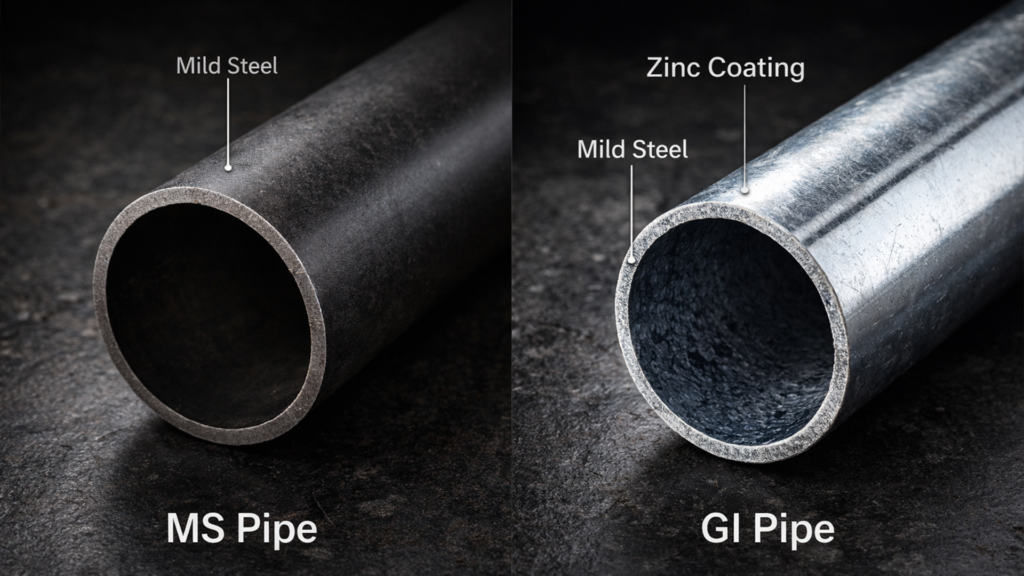
Steel pipes are widely used in construction, plumbing, fabrication, and industrial applications. Among the most commonly used types are MS (Mild Steel) Pipes and GI (Galvanized Iron) Pipes. Understanding their differences helps builders, contractors, and dealers choose the right material based on strength, durability, and usage requirements.
What Are MS Pipes?
MS Pipes (Mild Steel Pipes) are manufactured using low-carbon steel, which makes them strong, flexible, and easy to weld or fabricate. They are widely used in structural frameworks and industrial applications where strength and customization are important.
Key Features of MS Pipes
- High strength and load-bearing capacity.
- Easy cutting, welding, and fabrication.
- Suitable for heavy structural work.
- Cost-effective compared to coated pipes.
Common Applications
- Structural construction and building frameworks.
- Fencing and scaffolding.
- Industrial sheds and fabrication work.
- Machinery support structures.
What Are GI Pipes?
GI Pipes (Galvanized Iron Pipes) are steel pipes coated with a protective zinc layer through a galvanization process. This coating protects the pipe from rust and corrosion, making them ideal for water-related and outdoor applications.
Key Features of GI Pipes
- Strong corrosion resistance.
- Longer life in moisture-prone environments.
- Smooth internal surface for water flow.
- Low maintenance requirements.
Common Applications
- Water supply pipelines.
- Plumbing systems.
- Outdoor installations.
- Agricultural irrigation systems.
MS Pipe vs GI Pipe — Key Differences
| Feature | MS Pipes | GI Pipes |
|---|---|---|
| Material | Mild Steel | Zinc Coated Steel |
| Corrosion Resistance | Moderate | High |
| Strength | Very High | High |
| Welding & Fabrication | Easy | Limited after coating |
| Cost | More economical | Slightly higher |
| Best Use | Structural work | Water & outdoor use |
Which One Should You Use?
Choosing between MS and GI pipes depends on the application.
- For structural strength, fabrication, fencing, or industrial frameworks, MS pipes are preferred because of their durability and flexibility in welding and customization.
- For plumbing systems, water supply lines, or environments exposed to moisture, GI pipes are a better option due to their rust-resistant coating and longer life.
How to Identify Quality Pipes
- Check for proper company branding and certification marks.
- Ensure uniform thickness and smooth finishing.
- Inspect welding quality and surface coating.
- Verify weight standards as per specifications.
- Purchase only from trusted suppliers and authorized distributors.
Conclusion
Both MS and GI pipes serve important roles in construction and industrial projects. Selecting the right pipe depends on usage conditions, durability needs, and environmental exposure. Trusted suppliers like HMT Steel provide high-quality MS and GI pipe solutions designed to deliver strength, safety, and long-term performance.
— HMT Steel